
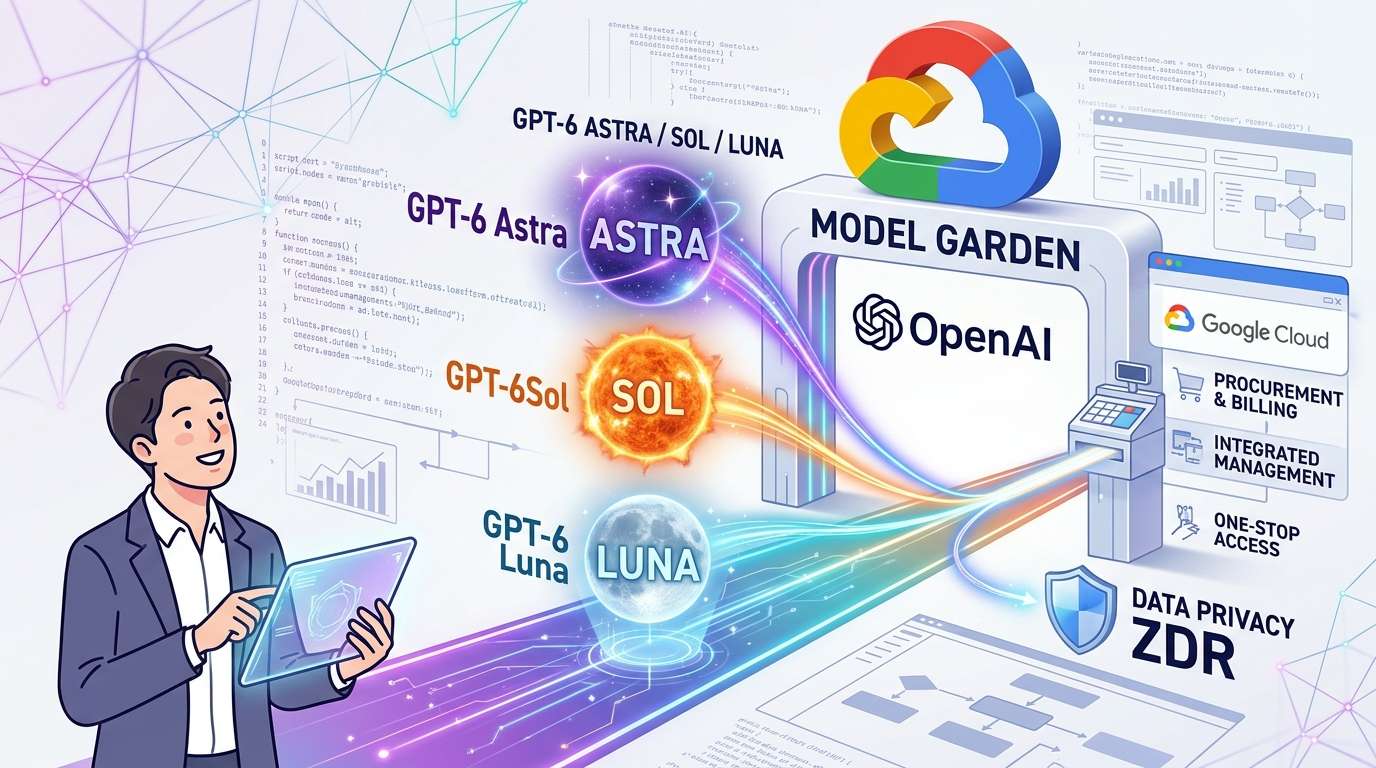
Google Cloud announced on October 21 (local time) that it had added three models, including OpenAI’s GPT-6 Astra, to its model catalog, Model Garden. The models are available in a private preview for select enterprise customers, enabling them to run on Google Cloud infrastructure and consolidate procurement, billing and management through Google Cloud.
The way businesses buy AI models could change
When it comes to using generative AI at work, discussions often focus first on which model is the smartest. But when it comes to implementation, the unglamorous details—contracts, billing and data handling—can take up a surprising amount of time.
This announcement is a move to address those unglamorous details. With the addition, Google Cloud is touting itself as the only hyperscaler where customers can use closed models from the three leading companies. A hyperscaler is a major cloud provider that operates vast data centers on a global scale. However, “the only” is Google Cloud’s own claim, so it should be understood as such.
The three models added—and how they differ from API access
The three models added to Model Garden are OpenAI’s GPT-6 Astra, described as its flagship model; GPT-6.1 Sol, aimed at users who prioritize cost-effectiveness; and GPT-6 Luna, a lightweight model. The lineup lets users choose according to their needs, whether they prioritize performance, lower costs or a lighter model.
In fact, it was already possible to access OpenAI models through APIs from Google Cloud. What changes now is that, with their listing in Model Garden, OpenAI models can run on Google Cloud infrastructure, while procurement, billing and management can all be consolidated through Google Cloud.
Think of it as going from shopping at separate stores to checking out at one mall’s register. For procurement and finance teams, the reduction in administrative work may matter as much as differences in model performance.
How companies should first check data handling
When companies adopt AI, data is an issue they cannot avoid. Google Cloud says that customer-entered prompts and context, along with model outputs, remain within designated boundaries and are not used to train models.
Google Cloud also says a zero data retention (ZDR) option will be available soon. ZDR refers to an approach in which the provider does not retain data exchanged with the service, making it a point of particular interest to industries that handle highly sensitive information.
The convenience of choosing from multiple models is appealing, but the final adoption decision will likely hinge on whether companies can verify that the data-management terms meet their requirements.
Operational ease matters more than the number of models
As options multiply, companies face a new challenge: how to organize contracts and management for each model. The key point of this announcement, in our view, is not simply the addition of another model, but the provision of a way to integrate OpenAI models into existing Google Cloud environments.
The models are initially available in a private preview for select enterprise customers, and Google Cloud says it will roll out more models over time. The criteria for choosing a cloud provider are expanding to include which models are available in a company’s own environment. This announcement offers a glimpse of that trend.









Comments