
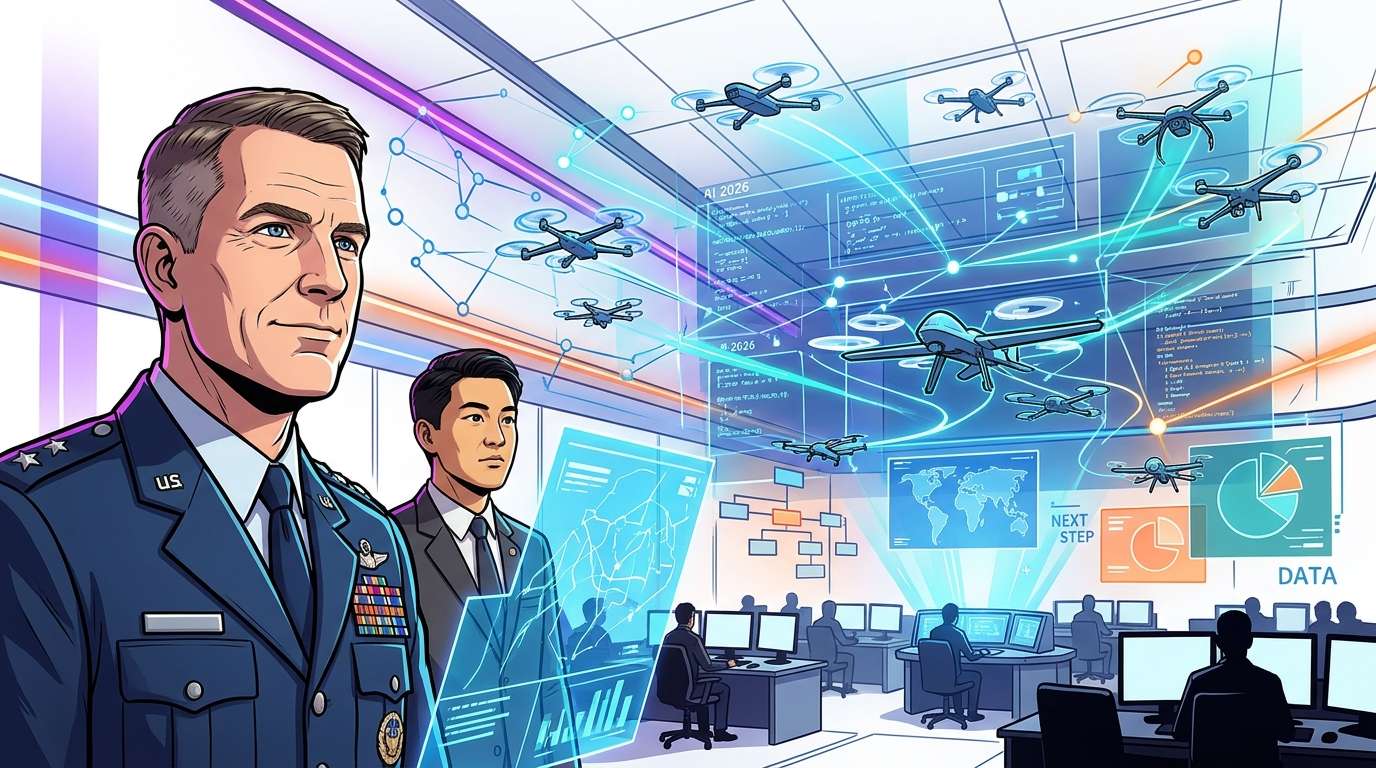
David Allvin, the former chief of staff and top uniformed officer of the U.S. Air Force, spoke with the Asahi Shimbun on Sept. 28, 2026, in Seoul, South Korea, where he was visiting. Citing the prominent role of drones in the war in Ukraine, he said that the success or failure of AI use in defense “will hold the key to the battlefields of the future.” He also said he sees Japan’s revision of its three security-related documents as a major opportunity to embrace technological innovation.
Drones put affordability on the battlefield
Allvin described the current use of drones as principal weapons in the war in Ukraine as one of the most important changes in warfare in recent decades. Unmanned aircraft may look like little machines flying through the sky, but they are fundamentally reshaping the economics of war.
The focus is not just on performance. Allvin pointed out that the advent of powerful, affordable weapons means it is now necessary to outmatch an adversary on cost as well. He said it is essential to leverage one’s own technologies and maintain the ability to keep producing weapons that are cheaper, available in large numbers and sufficiently powerful.
The shift is from acquiring a small number of expensive systems to ensuring a steady supply of affordable ones. The debate over defense appears to be expanding from a contest over specifications to one over factories and supply chains.
AI’s value lies in faster decision-making
When people hear “AI,” they often picture machines fighting in place of humans. Allvin takes a somewhat different view: rather than choosing between machines and people, it is important to bring the two together.
Allvin said the U.S. military uses AI-enabled command-and-control support systems, including the Maven Smart System, in operations against Iranian forces. He stressed that using AI in defense can improve the ability to make decisions faster than an adversary, and that an advantage in decision-making could be a game changer on the battlefield.
Command and control here refers to the process of gathering and organizing information about the situation on the battlefield and deciding what action to take. AI’s role is less to pull the trigger than to process vast amounts of information and quickly prepare material to inform human judgment. The same article also quotes a Middle East researcher who says that systems of this kind can complete analysis and target selection in tens of minutes—tasks that would take humans tens of days to do by hand. Speed is a major draw, but how to manage that speed is also a key question in this field.
How to turn private-sector innovation into military capability
Allvin said the United States and its allies will need to do more to connect private-sector technologies, including those developed by entrepreneurs, with military capabilities. AI and drones are areas where private companies stand out for their speed, making it a challenge to keep pace with government procurement cycles.
Could Japan’s revision of its three security documents be an opportunity?
On plans to strengthen Japan’s defense capabilities as part of the revision of its three security-related documents, Allvin said the country is entering an “extremely important period” for developing new technologies such as AI and cyber capabilities and building the means to produce them. He sees this as “a tremendous opportunity” to embrace technological innovation.
On strengthening the Japan-U.S. alliance, he also said Japan could take the lead in areas such as the private sector’s advanced space capabilities, autonomous systems technology, and the affordable mass production of equipment.
Put together, Allvin’s remarks on the affordability benchmark set by drones, the faster decisions enabled by AI, and links with private-sector technology point to an era in which defense competitiveness is determined not just in laboratories but by the breadth of the industrial base. Whether Japan can use the revision of its three documents as a foundation for this will be worth watching.








Comments