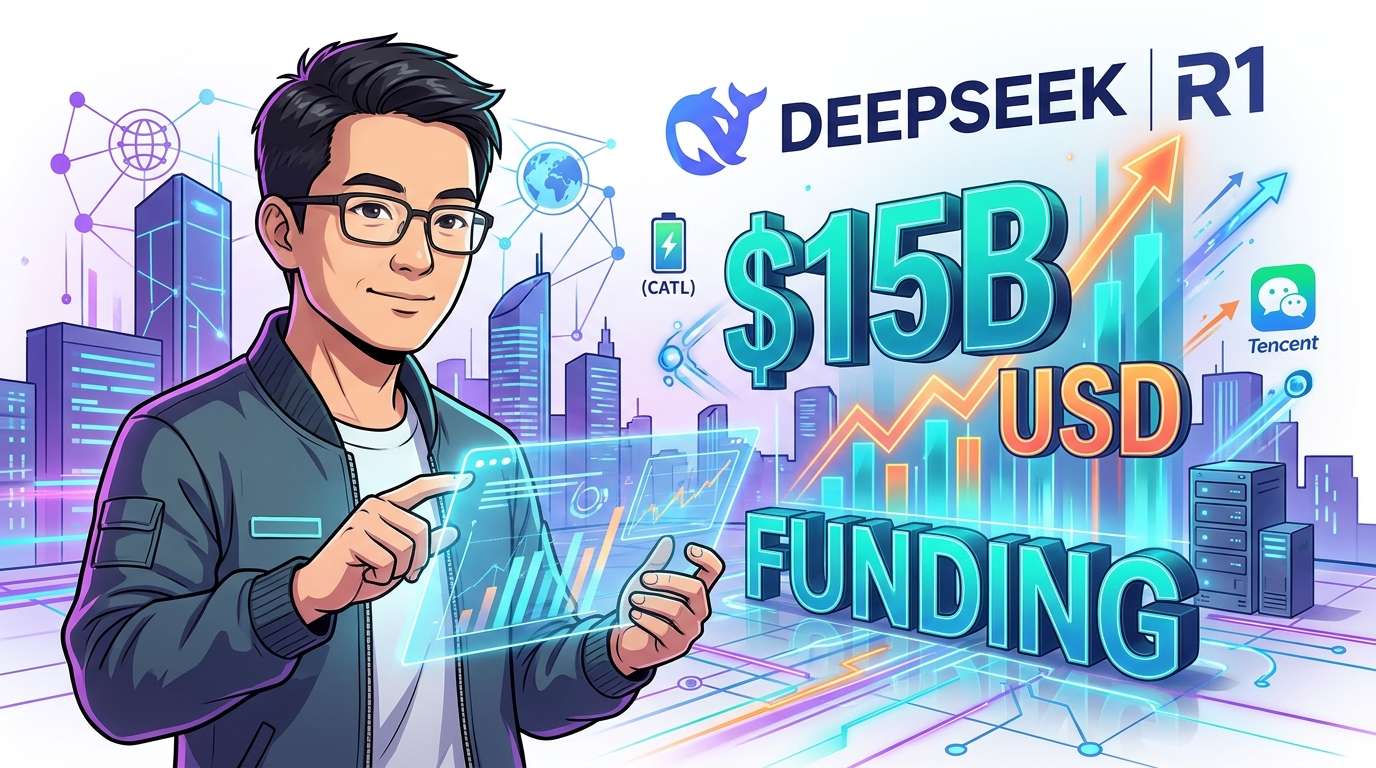
DeepSeek, an AI company based in Hangzhou, China, has reportedly raised about $15 billion (roughly 1 trillion yuan). The reported deal came two days after the U.S. government ordered civilian federal agencies to remove DeepSeek’s AI technology from their systems over security concerns. It is considered one of the largest fundraisings in China.
A massive fundraising round lands two days after the restrictions
Investors reportedly put together about $15 billion two days after Washington said, “Remove it.” The timing is dramatic, but there is no evidence that one event caused the other. Let’s start with what we know: separate forces—regulation and capital—were at work in the same week.
The U.S. measure applies to civilian federal agencies. It is distinct from a blanket ban on use by private companies or the general public, and it does not directly affect China, the foundation of DeepSeek’s business, or markets outside the United States. The fundraising report emerged against this backdrop, with those boundaries in place.
What the reported fundraising involves
According to reports, the amount raised was about $15 billion, equivalent to roughly 1 trillion yuan. Potential investors reportedly include battery giant CATL and Tencent, operator of the messaging app WeChat.
The names involved are worth noting. When people think of AI fundraising, they tend to picture semiconductor companies, cloud providers and investment funds. The inclusion of a battery maker appears to reflect how AI is becoming a force that spans entire industries. These are only potential investors at this stage, but the reports suggest that major Chinese companies may view DeepSeek as a promising investment.
Money is pouring into models and infrastructure
Reports say DeepSeek is increasing spending on AI infrastructure and open models. The investment is aimed at both the domestic Chinese market and overseas markets. It is worth noting that the company’s investment push also includes expanding abroad, even as use is restricted in the United States.
An open model is one that makes public the data underlying its AI, allowing third parties to use or modify it freely. In early 2025, DeepSeek drew global attention with R1, a free-to-use, open-weight reasoning model. At the time, it challenged the view that U.S. AI companies held the advantage. It is natural to see this latest funding as fuel for expanding computing capacity and developing the next generation of models, building on that momentum.
The race to secure computing infrastructure—in other words, the vast number of computers needed to run AI—requires sums on an entirely different scale. The $15 billion figure makes sense if you think of it as the price of staying in the game.
Putting the fundraising figures in context
As the figures pile up, it’s easy to get confused, so let’s put them in chronological order.
From June to July—and now
DeepSeek reportedly raised more than $7 billion in a June funding round at a valuation of $50 billion. In July, it was also reported to be seeking an additional $1.5 billion at a valuation of about $71 billion. At the same time, reports said the company planned to hold an initial public offering (IPO) in China as early as next year.
The roughly $15 billion reported this time is a separate development. It cannot simply be added to the previous fundraising totals or valuations, but the succession of fundraising reports over just a few months points to the scale of the company’s demand for capital.
Founded in 2023, DeepSeek has as its founder Liang Wenfeng, who also co-founded High-Flyer, a Chinese quantitative hedge fund. The fund backed DeepSeek’s early development. Data from WireScreen, which analyzes corporate ownership structures, estimates that Liang still holds an 81.6% stake in the Chinese operating entity, even after the latest funding round. The picture is one of substantial outside investment while control remains in the founder’s hands.
A wave of funding is spreading across Chinese AI companies
DeepSeek is not the only company attracting huge sums. Moonshot AI, developer of Kimi, raised $2 billion in May at a valuation of $20 billion. Manus AI raised more than $500 million this month.
Some companies have already gone public. Zhipu AI (Z.ai) and MiniMax listed in Hong Kong in January, with market capitalizations of about $29 billion and $7.2 billion, respectively. With a valuation above $50 billion while still privately held, DeepSeek is larger than the two listed companies.
An influx of capital could intensify competition among Chinese AI companies. DeepSeek’s expansion looks likely to affect not only its own models and pricing but also the strategies of its rivals.
An era in which regulation and capital move on separate tracks
What these reports reveal is that policy and investment around AI often move in different directions. Civilian federal agencies in the United States are moving to remove DeepSeek’s technology, while major companies in China are being mentioned as potential investors. The global AI race is not contained within a single set of values or a single market.
Today, AI competition is shaped not only by model performance, but also by which countries’ markets a company operates in, whose money funds it, and what regulations govern it. Reports that DeepSeek raised $15 billion are one example of how this divide is already showing up in the numbers.









Comments