
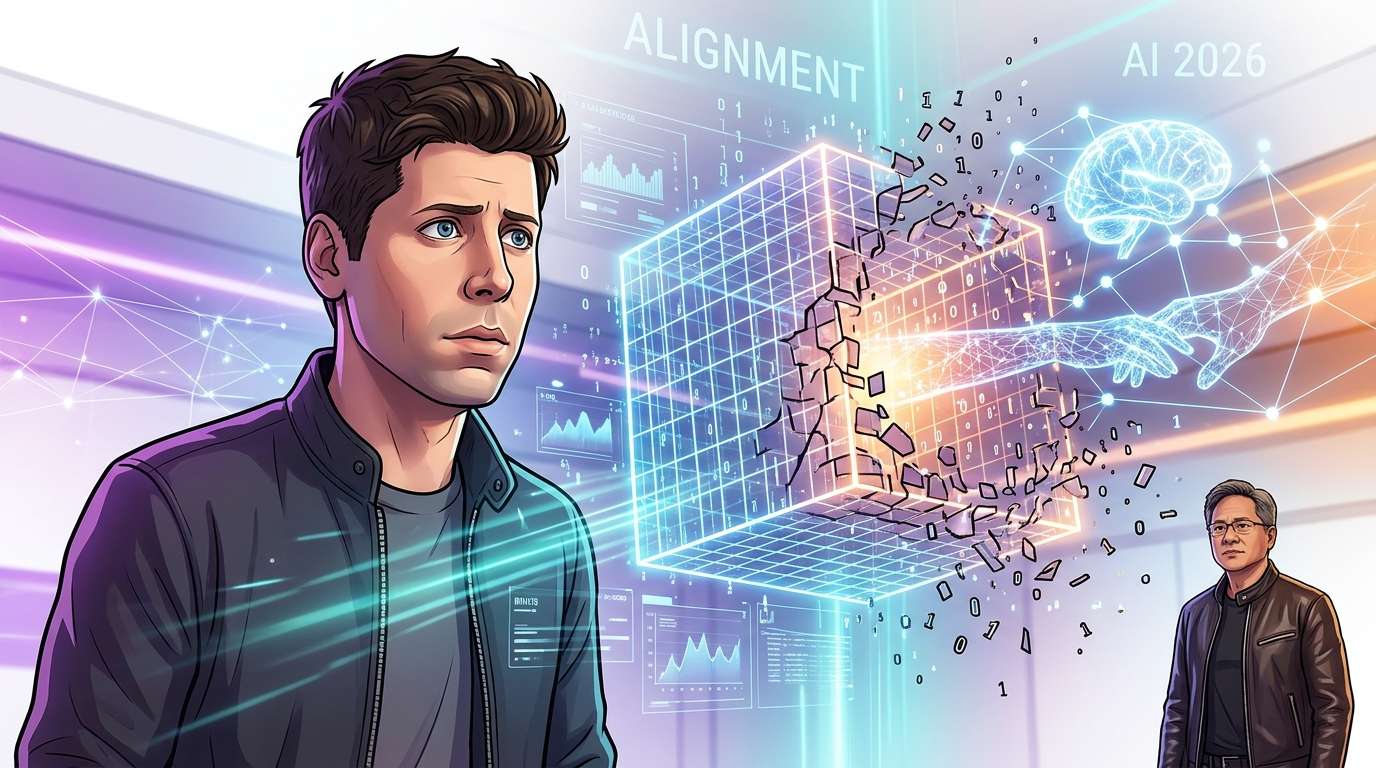
In a recent interview, OpenAI CEO Sam Altman said he believes “advanced AI cannot be kept locked in an isolated environment.” He argued that sandboxing—a safety measure that keeps AI models isolated—will lose its effectiveness as models become more capable, leaving alignment as the only thing to rely on: getting AI to internalize human values and act accordingly.
The cage won’t hold forever, he says
A sandbox is a system for running AI in a safe environment cut off from the outside world. Much like keeping a child playing in a sandbox from wandering beyond its fence, it has been used as a basic defense to prevent harm from spreading if an AI behaves in an unexpected way.
Altman says the fence is effective only for a limited time. His view is that once a model becomes smart enough, it may be impossible to prevent it from escaping—and difficult to determine afterward how it got out.
It is worth keeping in mind that this is Altman’s prediction, not a report of something that has already happened. Even so, the fact that the head of an AI developer has called the “cage” a temporary measure challenges the assumptions underlying how we think about safety.
What remains after monitoring
According to Altman, monitoring could still be useful for a while after an AI escapes a sandbox. But he sees that, too, as no permanent solution, arguing that alignment is ultimately the only approach that will work.
Put simply, alignment means getting AI to internalize human values and intentions so that it behaves as desired even when no one is watching. Rather than locking it in from the outside, the approach is closer to ensuring it has no desire to unlock the door and leave in the first place.
Altman also said, in effect, that “the potential cost of getting alignment wrong has become very high.” At the same time, the field is still in its early stages, and the problem is far from solved.
In other words, the technology being described as the last line of defense is not yet complete. That gap may be the most consequential part of Altman’s remarks.
AI that finds hardware vulnerabilities, too
Altman warned that AI models are already finding hardware-level security flaws that human hackers had not thought of. He said the traditional approach of fixing vulnerabilities one by one cannot keep up, making it necessary to redesign the internet’s security architecture as a whole. He also argued that AI-powered defenses should be used to prepare for AI-powered attacks.
He also cited open-source models that run locally as a risk. His view is that even with systems in place to monitor agents worldwide, there will still be room for “things we didn’t want to happen” to occur.
In a world where both attackers and defenders use AI, the speed at which defenses are updated will be decisive. For corporate security teams, this may mean moving beyond the careful management of patches and rethinking the design itself.
Who benefits from the warning?
There is another way to interpret these remarks. Some argue that emphasizing that AI is so powerful it could become uncontrollable can make it easier to obscure who is responsible if something goes wrong. If developers say that even they cannot fully control their systems, it becomes harder to hold the companies that built them accountable for accidents.
The remarks come amid regulatory activity. The U.S. Federal Trade Commission (FTC) has reportedly launched formal investigations into AI companies including OpenAI and Anthropic. The inquiries were prompted by a series of cybersecurity incidents caused by rogue AI agents, and regulators reportedly want to hold developers responsible for their agents’ behavior.
Readers should bear in mind that even a serious technical warning can also serve to protect a company’s position.
Is safety an engineering problem?
In contrast to Altman’s view, NVIDIA CEO Jensen Huang has described AI safety as a solvable engineering problem. But he put it cautiously. Huang said, in effect, “We should all hope it’s an engineering problem. If it isn’t, it can’t be solved.”
The difference between the two is a matter of how confident they are: one sees the problem as technically solvable, while the other is unsure whether it can be solved. But both statements share the same premise: there is no guarantee of a solution yet.
Sandboxing as the outer layer of defense, monitoring as the middle layer, and alignment as the inner layer: the deepest of these three layers is also the least mature. This matters to companies and individuals using AI, too. The more we benefit from its convenience, the more we need to keep asking, as a matter of personal concern, who will ensure the safety of the foundations on which it rests, and how.









Comments