
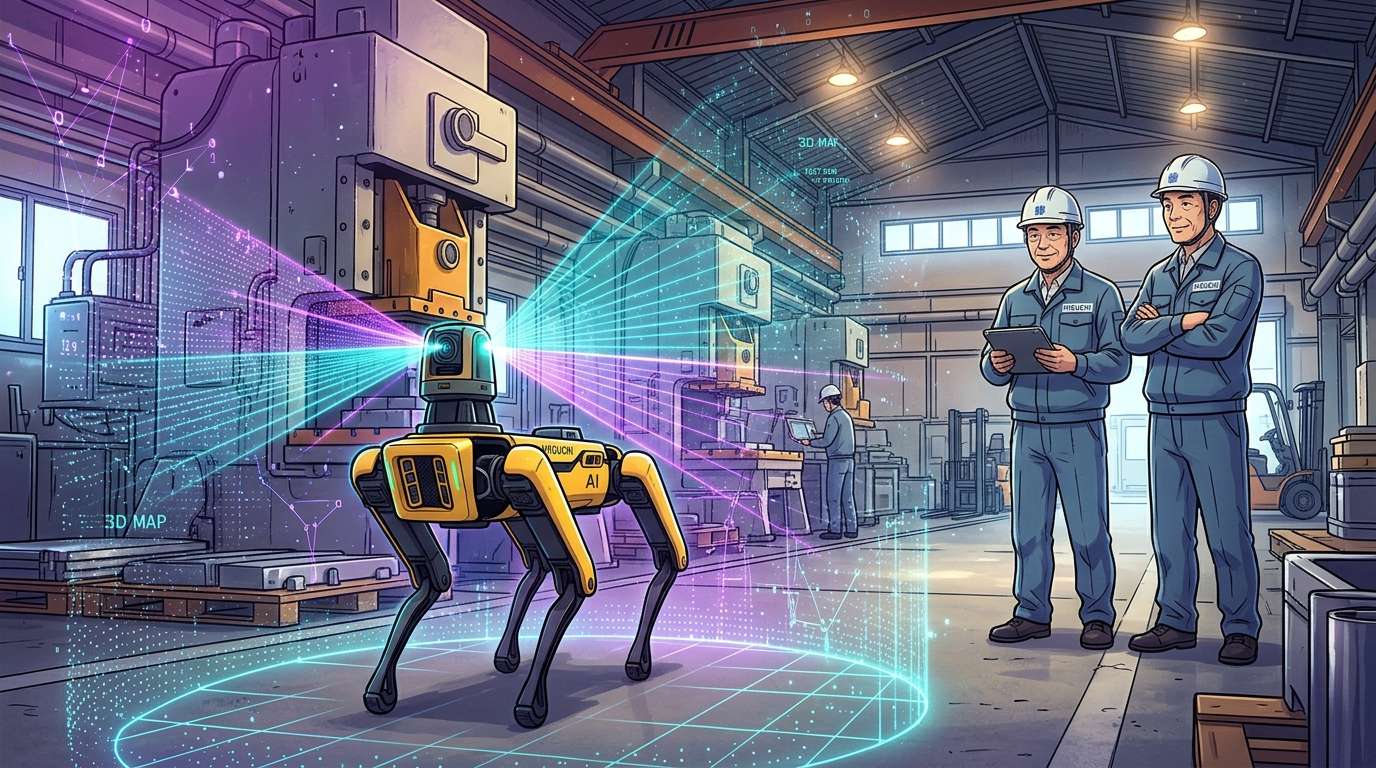
Higuchi Manufacturing Co., Ltd., a Japanese precision metal stamping manufacturer based in Kakamigahara, Gifu Prefecture, announced that it has achieved autonomous patrols inside its headquarters factory using a quadruped robot. At this stage, the company is verifying the creation of a 3D map of the factory using LiDAR and the robot’s ability to travel in the same aisles as workers. It plans to tackle anomaly detection using cameras and AI in the next phase.
A Japanese SME Manufacturer’s Choice: “Get It Walking First”
When people hear “physical AI,” many may picture robots that perform tasks as deftly as humans. But Higuchi Manufacturing’s initiative is more grounded: It tasked a robot with walking around the factory on its own.
Founded in 1937, the company has 272 employees. Headquartered in Kakamigahara, Gifu Prefecture, it is a Japanese precision metal stamping manufacturer with locations in the United States, Mexico and China. It was selected for the Ministry of Economy, Trade and Industry’s DX Selection program in both 2022 and 2025, and has been gradually digitizing production management and manufacturing operations since 2018. It is also working to operate a local generative AI system using internal company data.
The company is now taking AI initiatives that have so far played out on screens into the physical workplace. The first step is introducing a quadruped robot. It may not be flashy, but this is a case worth watching as a practical path for a regional SME manufacturer to venture into physical AI.
What’s Been Confirmed: Factory Navigation and Mapping
The testing is taking place at the company’s headquarters factory. The robot uses LiDAR—a sensor that measures the distance to its surroundings with laser light—to create a 3D map of the factory, then patrols autonomously. The company also tested whether it could travel safely in the same aisles as workers.
For operations, the company used a closed network physically isolated from external networks and says it verified through actual measurements that external communications were blocked. For a robot moving around inside a factory, keeping information flows contained should offer manufacturers peace of mind.
For now, the focus is not on “AI that detects anomalies” but on a system that can patrol the factory without getting lost. Keeping that distinction in mind makes it easier to understand the significance of the announcement.
Challenges Unique to the Factory Floor
Putting the robot to work also brought challenges to light, including turning in tight spaces, crossing paths with forklifts and moving aside in unexpected situations. The company says it will work to address all of these in the next phase.
Factory floors don’t behave as neatly as product catalogs suggest. In existing workplaces with uneven surfaces, cables and narrow aisles, people, vehicles and robots must share the same space. Identifying these challenges at the outset could prove important as the company moves on to anomaly detection.
The Goal: Give Managers Their Time Back
Routine patrol inspections on the manufacturing floor are meant to check worker safety and identify equipment abnormalities. The work can depend heavily on the experience of floor managers and is no small burden. The announcement also notes that labor shortages in manufacturing are worsening year by year, citing an estimate that Japan will face a labor supply shortfall of about 11 million people by 2040.
The company aims to have robots take over the safety patrols that managers have handled, freeing up their time for work focused on shaping the future. A key priority is making the system suitable for existing factories without major changes to equipment or layouts. The idea is to adapt to workplaces as they are, rather than make a major investment such as building a new factory.
Kiyotaka Ishida, a senior managing executive officer, said that introducing a robot is not an end in itself. The company wanted to see whether the “insights” developed by skilled workers could be captured as data and passed on to the next generation. What stands out is that it sees autonomous patrols not just as a way to automate rounds, but as a starting point for turning veterans’ instincts into records.
Masahiko Hori, head of manufacturing, said he was initially skeptical. But after seeing the robot choose its own path through the aisles, he felt the day when it could be entrusted with patrols was close.
Anomaly Detection Is Still to Come
The current demonstration is the second phase of a four-stage project. In the next phase, the company plans to begin testing anomaly detection using a camera mounted on the robot and AI.
Ultimately, the company is developing the system with the aim of notifying managers when an anomaly is detected and automatically shutting down equipment. It is also considering automatically generating patrol records and reports, as well as connecting the system to its existing internal data platform. Its ultimate goal is a “Generative AI and Physical AI Factory” that combines generative AI with physical AI.
Notifications and automatic shutdowns remain goals for the future. What the company has achieved so far is autonomous patrol—the foundation for those capabilities.
The company plans to share the knowledge and challenges gained through the demonstration at discussions with regional manufacturers and educational institutions. In a field of physical AI where high-profile examples tend to come from large companies, the step-by-step progress of a regional SME could offer useful lessons to factories facing similar challenges.







Comments