
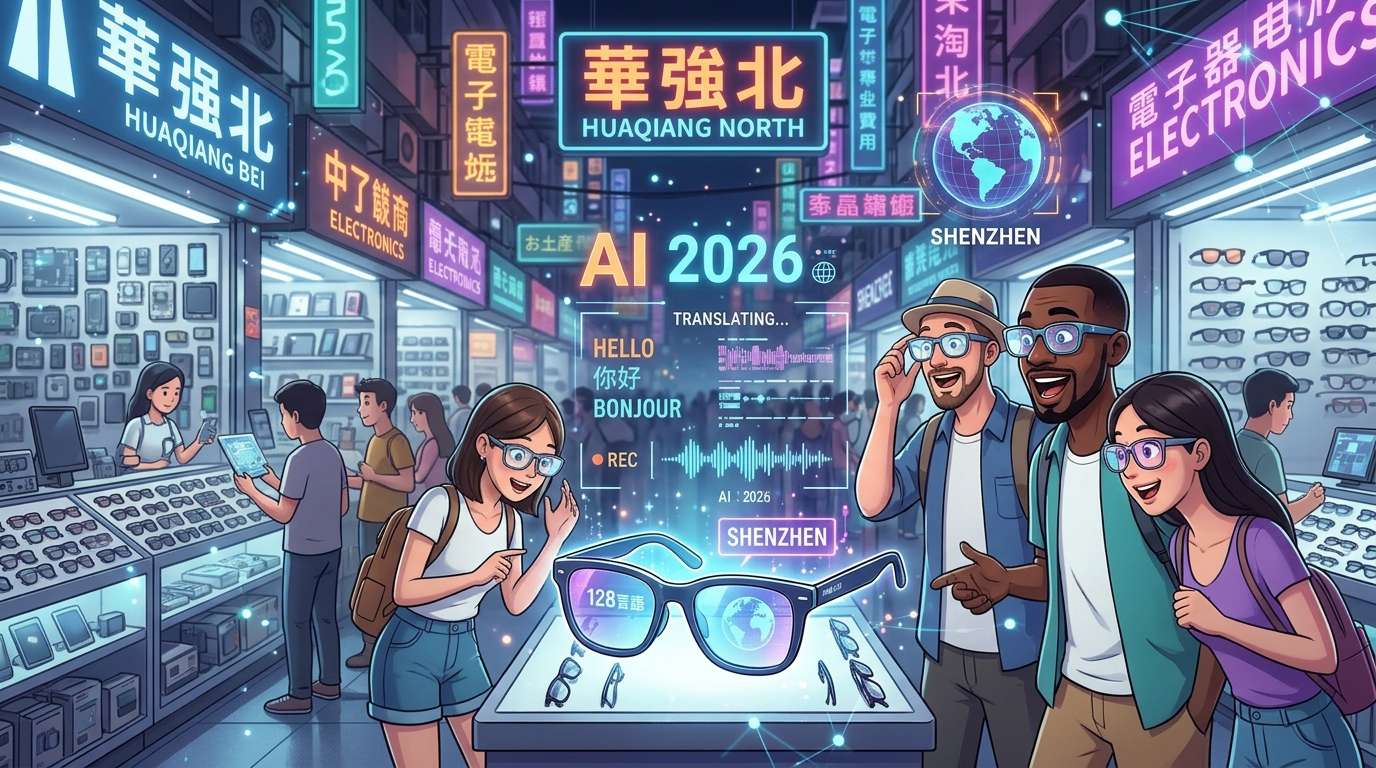
In Huaqiangbei, an electronics district in Shenzhen, Guangdong province, foreign tourists are increasingly stopping to try AI glasses—eyewear-style devices equipped with artificial intelligence (AI). Sales of AI products rose more than 55% year over year from January to July 2026, while sales of AI glasses doubled. Xinhua reported the figures on October 23, as shopping while traveling increasingly becomes a gateway to new high-tech products.
A Rush to Try on Glasses in the Electronics District
Huaqiangbei, also known as “China’s No. 1 Electronics Street,” is one of the country’s largest electronics districts. It is home to more than 115,000 businesses and 35 specialized markets, offering over a million types of electronic components and consumer electronics. Imagine Akihabara several times over, and you may get close to picturing the place.
Foreign tourists are said to be a constant presence in the district’s central streets. This time, the main attraction was not a smartphone or a home appliance, but a device shaped like a pair of glasses.
Here are the figures: From January to July, sales of AI products rose more than 55% year over year. Sales of AI glasses doubled. It is important to note that these figures are for Huaqiangbei, a single commercial district—not the global market as a whole. Even so, the fact that sales are moving at this pace in a place where tourists can see, try on and buy the products for themselves is significant.
Translation and Recording in a Single Pair of Glasses
Hattin, a visitor from South Africa, was trying on one pair of AI glasses after another. “You can record video while talking, and the translated audio comes directly to your ears,” Hattin said, praising their capabilities.
What stands out is the way people choose which features matter. AI glasses may sound complicated, but the most appealing capabilities are things travelers can use right away: “recording while talking” and “hearing the other person’s words translated right by your ear.” It is easy to see the benefit of no longer having to pull out a phone and show each other the screen.
AI glasses launched by Shenzhen-based startup Shenzhen Liweike Technology are said to support simultaneous translation in 128 languages. Accuracy exceeds 98% for some minority languages, and the glasses are also being presented as useful for international cooperation and trade negotiations.
That said, the 98% figure applies only to some minority languages. It does not mean the same level of accuracy is achieved across all languages. The same translation feature has two different uses—shopping while traveling and business negotiations—which seems to be broadening interest in the product.
Shenzhen’s Industrial Cluster Fuels the Buzz on the Shop Floor
One reason Shenzhen has become a global hub for AI glasses is that it has a complete industrial chain. The city has more than 40 years of experience in the eyewear industry, and companies across the upstream and downstream segments of key areas such as branding, optics and displays have been emerging in the AI glasses sector.
It is as if a new AI-powered core has been added to the established foundation of eyewear manufacturing.
Different Roles for Nanshan, Bao’an and Longgang Districts
The industrial chain spans districts including Nanshan, Bao’an and Longgang. Longgang is a production hub that turns out more than 125 million pairs of glasses a year. Nanshan is home to a cluster of AI companies, including Tencent Holdings and Thunderbird Innovation Technology.
Bao’an has a strong industrial base in audio and displays, and is home to suppliers such as Luxshare Precision Industry and Pengding Holdings. Eyewear manufacturing, AI expertise, and audio and visual components: the elements needed for AI glasses are divided among companies across the same city.
The companies cited here are examples of the industrial base in each district; this does not mean that any particular company makes specific products. Even so, the close proximity of product planning, parts sourcing and manufacturing is likely helping give local stores such a wide selection.
Tourists’ Purchases Point to a New Point of Contact
Until now, AI has been something people use on a screen: asking questions in a chat or having it create images. When it moves into a wearable device like glasses, the ways people can use it become much closer to everyday life.
The combination of being able to try the product at a store while traveling and having an easy-to-understand feature such as translation may make it especially effective at prompting a purchase. Rather than reading a catalog’s specifications, hearing someone’s words in your ear the moment you put the glasses on is a far more convincing experience.
On overseas social media, many users reportedly see Shenzhen as “one of the most futuristic cities in the world.” Since the start of this year, foreign nationals have made more than 5 million entry and exit trips through Shenzhen’s ports. This flow of people is bringing opportunities to try new products to Huaqiangbei’s shops.
In Japan, too, it is not unusual for gadgets bought while traveling to spread by word of mouth after people return home. If AI glasses make their way around the world as “translation devices that also make great souvenirs,” the next place they become a talking point may be the shelves of an electronics store closer to home.








Comments