
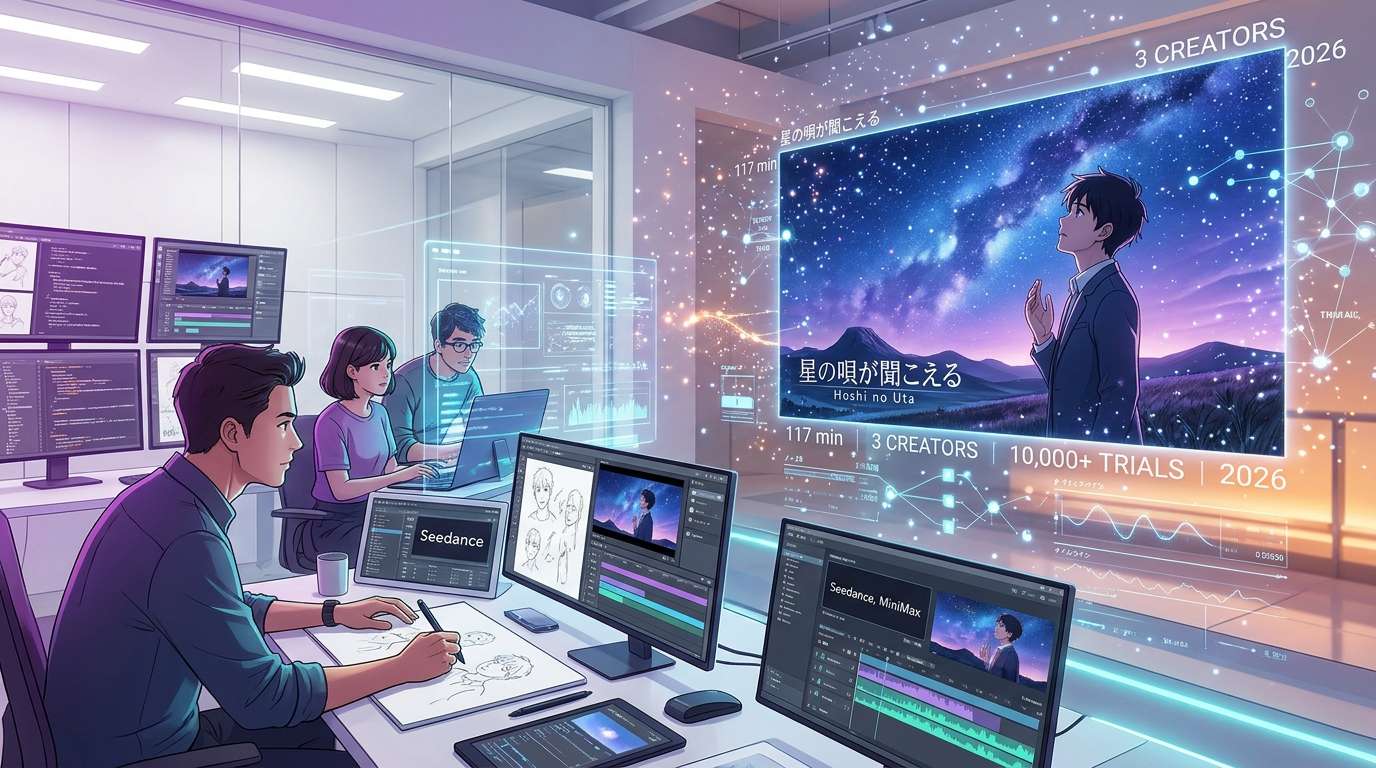
On October 22, 2026, known as Anime Day, the feature-length animated film “I Can Hear the Stars Singing,” made entirely with generative AI, was released for free on YouTube. It runs 117 minutes and was produced by a team of just three people. Production reportedly began in April 2026, then resumed in August, with the film completed after about three months of active work. Multiple AI tools were used to generate the footage, and the team made more than 10,000 attempts across roughly 1,500 shots.
What the figures—three people and 117 minutes—tell us
First, consider the numbers: a 117-minute runtime, about 1,500 shots, roughly three months of active work and a three-person production team. Anyone familiar with a typical feature-length animated film may find that combination surprising. Production began in April 2026, but was paused once to concentrate resources, then resumed in August of the same year. That means the film was completed after about three months of active work from the restart.
AI tools such as Seedance and MiniMax were used to generate video. For images, the team used ChatGPT image, Nano Banana and Midjourney; for music, Suno. Rather than relying on one tool for everything, they selected different ones to suit each scene. Generative AI filmmaking seems to be advancing through this kind of “toolbox” approach.
Making a feature-length film takes more than simply using AI
For a short video, a few tries may be enough to get something close to what you want. Feature-length films are different. The backgrounds, composition, characters’ appearances and emotional arc must remain consistent from beginning to end for viewers to become immersed in the story. Director Hirotaka Yuino has also explained that longer works pose challenges in keeping backgrounds and composition from breaking down, maintaining consistency in the characters, and preserving emotional continuity. That is why shorter formats, such as short-form anime and music videos, have become more common.
The team averaged more than five retakes for each of the film’s roughly 1,500 shots, for a total of more than 10,000 attempts. Those figures are the opposite of the impression that “AI can do it in an instant.” With each generation, the team selected images that fit the story; when they didn’t, they rewrote the prompts and tried again. That cycle, you could say, was the substance of the production process.
In other words, AI handled part of the work of “drawing,” while the decisions about “what to draw and which version to use” remained with people. That is the point to watch most closely in assessing where feature-length AI filmmaking stands today.
A question about achievement at the heart of the story
The film’s protagonist is Rei Shinomiya, an entrepreneur who lost both parents at a young age and grew up believing that achieving results was the only way to feel worthwhile. Sensitive to other people’s feelings, Rei is unable to hear the voice of their own heart. As the business succeeds, Rei loses sight of friends, family and, ultimately, themself.
The turning point is a simple prayer, passed down in Aso, Kumamoto: “make a wish upon a star.” Through that prayer, Rei gradually regains a sense of humanity. The film is presented as a parable about modern people who, driven by results and numbers, find themselves wondering, “What am I working so hard for?”
The story is described as an original work of fiction inspired by the real-life experiences of Yuino, who is both its director and an entrepreneur. A story about people driven by numbers was made through the accumulation of more than 10,000 attempts—a different kind of accumulation of numbers. There is an intriguing irony in that, or perhaps a sense of inevitability.
If AI is a partner, what role do people play?
Yuino describes the film not as a project that treats AI as a “cost-effective tool” or an instance of “technology theft,” but as a record of honing prompting techniques for scene creation, with AI as a “partner that expands creativity.” Yuino also said that anime works were not directly incorporated into the prompts or references. The delicate scenic beauty associated with Makoto Shinkai’s films and the landscapes of Aso, Kumamoto, were created by carefully revising the prompts, Yuino said.
The production has also specified where people’s work came in. Actual voice actors were cast in the main roles, with AI voices used for some parts. The team said that all lyrics, scripts and prompts were written by hand. Yuino handled the original story, script, direction, storyboards, music, backgrounds, character design, sound effects and editing, with two other people supporting video production and sound effects.
The production team says the cost was about one-tenth that of a typical animated film. It also noted that costs could fall further as the workflow becomes clearer. These figures come from the production team, and the basis for comparison was not disclosed. Even so, the fact that a small team can take on a feature-length film suggests that the barriers to production are changing.
What interests me is how the competitive landscape will evolve from here. The faster video can be generated, the more the differences may come down to the strength of the script and the ability to pick “the one” from countless options. AI excels at producing volume; people compete through selection and the creation of meaning. The film’s figure of more than 10,000 attempts seems to reflect that.
The decision to release it for free—and what comes next
The film is not intended to generate profit and is expected to remain freely available as a way of sharing technical expertise. At a time when the unauthorized use of AI-generated video and voice actors’ recordings is drawing criticism, releasing the work while also disclosing the production process and tools used offers one possible model.
Looking ahead, Yuino said they hope to advance animation across a wide range of genres—including battle scenes, love stories, children’s content, and commissioned original anime—while protecting and respecting the efforts and culture of past animators and manga artists. Yuino also expressed a desire to help Japanese culture reach a global audience.
The film was produced by DELINE PRIME (SPEED EFFECT Co., Ltd.), with J.P.C. Co., Ltd., Amusement Media Academy, and the NPO Oshidoishi no Oka listed as collaborators. It is available for free on YouTube. Why not see for yourself what a 117-minute feature has to offer? The official viewing page can be found via the Anime! Anime! article: https://animeanime.jp/article/2026/10/22/104090.html









Comments