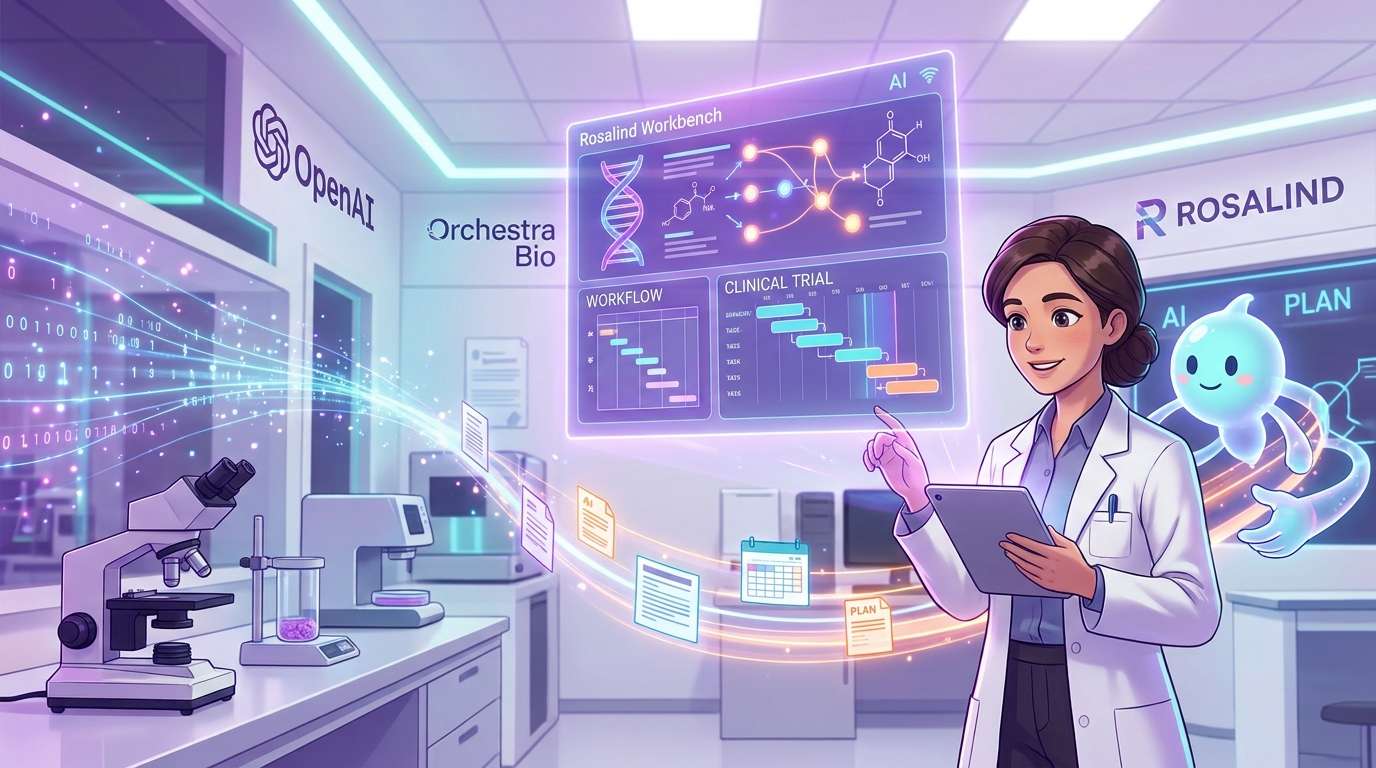
OpenAI announced on Oct. 20, U.S. time, that it had acquired Orchestra Bio, which develops an operations management platform for biopharmaceutical companies. The terms of the deal, including its price, were not disclosed. Orchestra Bio’s team and technology will be integrated into OpenAI’s suite of AI models and tools for life sciences, “Rosalind.”
Drug-discovery AI ventures beyond the lab
When people hear about combining drug discovery and AI, many may picture AI finding a new compound. This acquisition points to a field just beyond that. Before a drug reaches patients, the work of coordinating the process can be just as demanding as coming up with experiments and analyzing results. OpenAI is looking to bring AI into that coordination work, too.
Rosalind has two components. One is “GPT-Rosalind,” which supports reasoning about biology and chemistry. The other is “Rosalind Workbench,” which connects scientific tools and data to support analysis and experiment planning. It may help to think of the former as the brain and the latter as a workbench.
Orchestra Bio’s technology will add to this. OpenAI says it plans to develop AI agents that connect research findings to subsequent trials and decisions. An AI agent is an AI system that takes instructions and carries out multiple tasks autonomously. The result is a system that not only helps with individual experiments but also fills the gaps between stages of the process.
Spotting signs of delays and laying out possible responses
Orchestra Bio’s platform allows researchers and program leads to delegate the monitoring and tracking of trials and development plans to AI agents. One example it gives is a situation in which a manufacturing problem threatens to delay a clinical trial. In that case, the system identifies affected tasks and schedules, then brings together relevant information and possible responses.
One point worth noting is that researchers and program leads make the final decisions. The division of responsibility is clear: AI organizes the situation, while humans decide what to do. OpenAI has not announced plans to automate research decisions themselves; its approach assumes that AI will organize information and manage progress, while scientists make the decisions.
In a corporate setting, it might resemble a situation where project updates are scattered across multiple systems and someone has to pull together the materials before the weekly status meeting. AI would take on that information-gathering role. It may not be flashy, but it addresses a real burden on the people doing the work.
Decisions and coordination underpin a journey of more than a decade
According to OpenAI, in the United States, it takes an average of 10 to 15 years to go from discovering a drug target to regulatory approval. Beyond the research itself, the process involves many stages, including coordination among internal departments and external companies, trial planning, manufacturing, and regulatory work. Information can also be spread across disconnected systems. OpenAI says AI can support both specialized tasks and complex program management.
OpenAI is already partnering with Novo Nordisk on research and development and business operations. It also provides AI to Moderna for developing experimental procedures from complex data. With this acquisition, Rosalind’s scope will expand beyond ideation, experimental design, and interpreting results to include coordinating the work needed to move drug candidates into development.
When assessing the value of AI in drug discovery, we tend to focus on how promising a candidate it can produce. But over a journey that takes more than a decade, the ability to connect each stage and spot early signs of delays can matter just as much to the outcome. AI is moving from a tool that helps scientists develop ideas to one that helps them see the bigger picture across a project. This acquisition marks a step in that direction.








Comments