
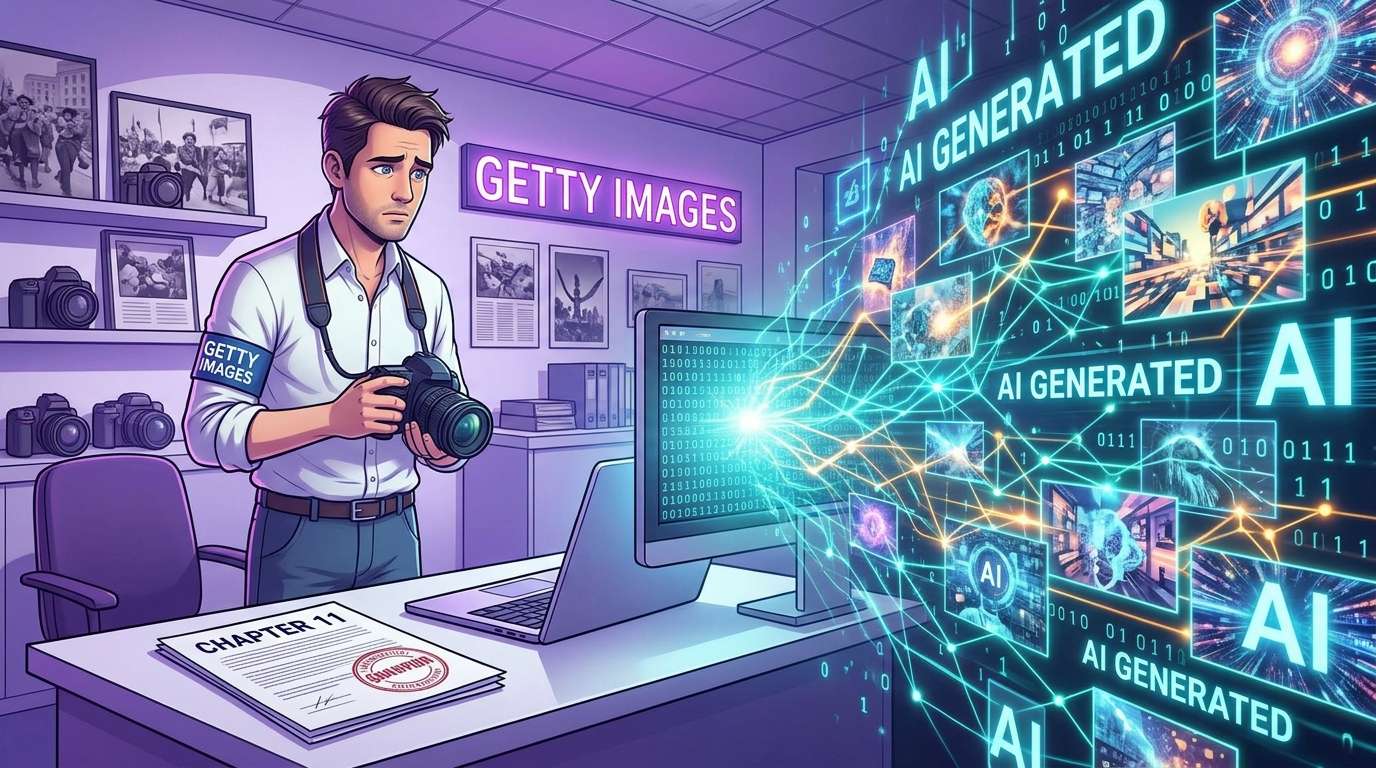
Getty Images, the U.S. photo and video provider, announced on the 21st that it had filed for Chapter 11 bankruptcy protection in a Delaware court. The company, which has supplied photos to news organizations and others around the world, had been struggling amid intensifying competition from generative AI images and was carrying substantial debt.
A Company That Has Supported Newsrooms Files for Chapter 11
Getty Images is a major image provider with a wide-ranging collection that includes news photos, sports, entertainment, illustrations and video. News organizations around the world are among its customers, and many people have probably noticed the company’s name in small print accompanying photos they have seen in newspapers or on news websites.
The company has filed for Chapter 11 bankruptcy protection in a Delaware court. The reason cited for its worsening business conditions is intensifying competition from generative AI images. This is a symbolic event for those who take and sell images.
A Chapter 11 Filing Does Not Mean the Business Is Shutting Down
The first thing to understand is what Chapter 11 of the U.S. Bankruptcy Code means. It is a process comparable to Japan’s Civil Rehabilitation Act, providing a framework for reorganizing debt while continuing operations and seeking a turnaround. The word “bankruptcy” can make it sound as though a company will disappear right away, but filing for Chapter 11 and ending operations are two different things.
What can be confirmed from this announcement is that the company filed for Chapter 11 and had substantial debt. A path to reorganization will take shape through the proceedings ahead.
Generative AI Images Have Become Competitors in the Photo Business
The factor cited in Getty’s worsening business conditions was competition from generative AI images. In an era when an image can appear seconds after someone types in a prompt, established image providers have found themselves facing a powerful competitor.
Images where “it’s enough if the mood is right,” such as advertising visuals or blog thumbnails, are particularly well suited to AI. There is the effort of choosing a photo and paying a licensing fee, versus the ease of writing a prompt and generating an image. If that gap keeps widening, it is hardly surprising that it could affect the revenue model of image providers.
Breaking Down the Nature of the Competition
However, it is important to note that AI images have not replaced every part of the photo business. In newsrooms, photos of events that actually happened have value in and of themselves. Generated images are different in nature from records of reality.
In other words, the reality is likely closer to a picture of competition unfolding unevenly across different uses than one in which it affects the entire market for photography. This is my assessment, but it would be premature to leap from this filing to the conclusion that it marks “the end of photography.”
It’s Not Just the Supply of Images That Matters
Now that there are more ways to obtain images, what do news organizations and businesses want from established photo services? If all they need is access to images, AI is also an option. What will remain important, I believe, are factors such as knowing clearly when, where and by whom an image was taken, having rights in order, and being able to reliably find the one image needed among a vast collection.
These are not facts that can be directly gleaned from this filing; they are simply issues to consider. Still, as AI images become commonplace, the value of “genuine records” and “assets with clear rights” may stand out more by comparison.
The reorganization of a major company that has delivered photos to news organizations around the world is likely to serve as a mirror for where the image business as a whole is headed in the age of AI. The course of the proceedings ahead will provide concrete material for the debate over the value of photography.









Comments